Impersonation mode
Impersonation mode allows authorized users to temporarily access Sally from another user’s perspective.
This feature is designed for business continuity scenarios, such as illness, vacation, or unexpected absence, where access to meeting documentation, tasks, or recordings is required to maintain ongoing operations.
Impersonation does not grant additional permissions. Actions are always limited to the role and rights of the impersonated user.
If you would like to disable the impersonation feature organization-wide, please contact us. Upon request, we will fully deactivate the feature for your organization.
Quick Navigation:
- Role permissions
- How to impersonate a user
2.1. Permissions in impersonation mode - Exit impersonation mode
- Data protection and compliance
1. Role permissions
Impersonation is restricted by role to ensure controlled and traceable access:
| Impersonating ↓ / Target → | Owner | Admin | Member |
|---|---|---|---|
| Owner | ✅ | ✅ | ✅ |
| Admin | ❌ | ✅ | ✅ |
| Member | ❌ | ❌ | ❌ |
This hierarchical structure ensures that impersonation follows your organization’s defined responsibility and access model.
2. How to impersonate a user
Follow these steps to activate impersonation mode:
- Navigate to Settings.
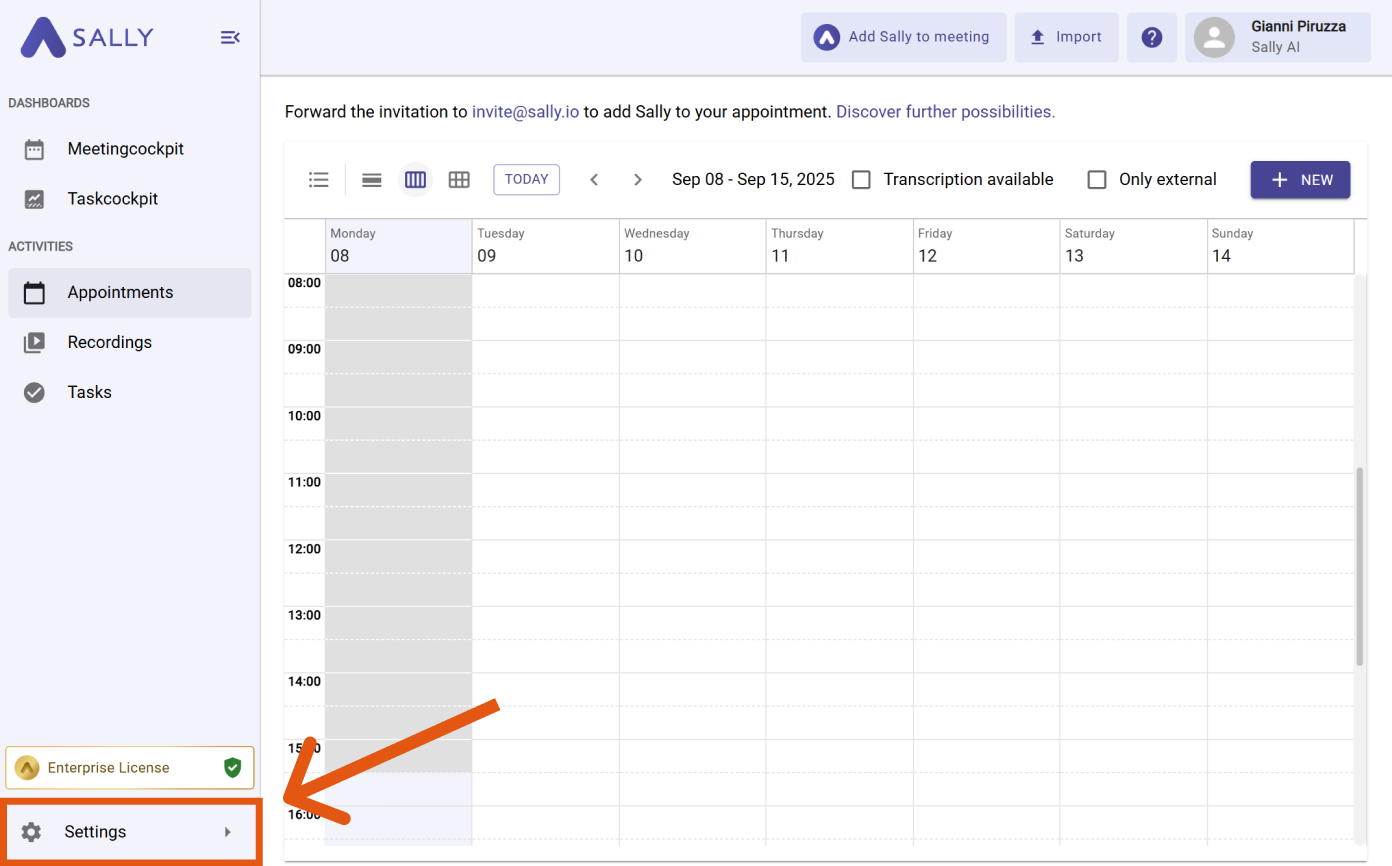
Navigate to Settings → Users
- Select Users under Administration.
- Locate the user you want to impersonate and click the Impersonation icon in the Actions column.
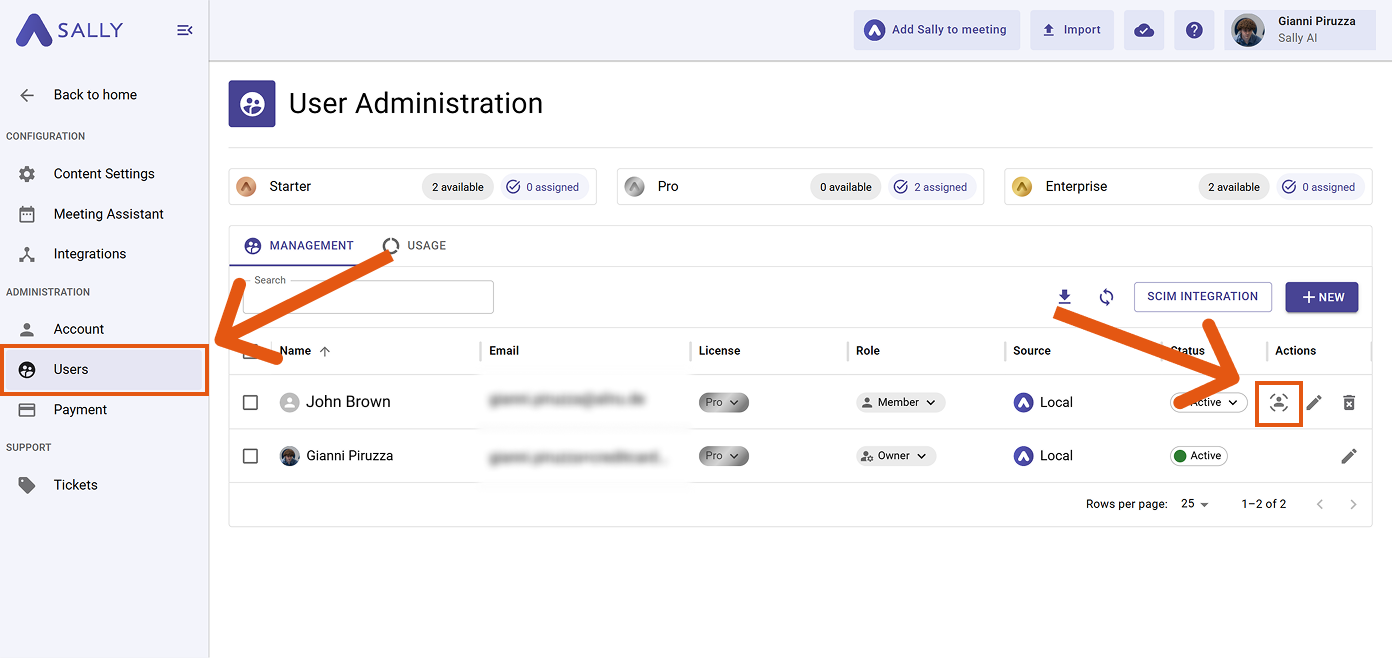
Click the impersonation icon next to the selected user
You are now in impersonation mode. You can recognize this in the top-right user menu: an exclamation mark indicates that impersonation is currently active.
2.1. Permissions in Impersonation Mode
In impersonation mode, you assume exactly the role and permissions of the user you are impersonating.
This means:
- You have all the rights that this user has.
- You do not have any additional rights.
- Your own role (e.g., Owner or Admin) is not active during impersonation.
While impersonating, you operate entirely within the permission context of the target user.
What this means in practice:
- If the user is allowed to view meetings, you can view them as well.
- If the user is allowed to add Sally to meetings, you can do so as well.
- If the user is not allowed to change system-wide settings, you cannot do so either.
Impersonation is not a separate permission level, but a temporary perspective switch to an existing user.
For example, if an Owner impersonates a Member, only the Member’s permissions are available during impersonation. Extended Owner permissions are not active at that time.
Impersonation mode never results in an extension or circumvention of existing role, license, or access restrictions.
3. Exit impersonation mode
To leave impersonation mode:
- Click on the user menu in the top-right corner.
- Select “Exit impersonation mode”.
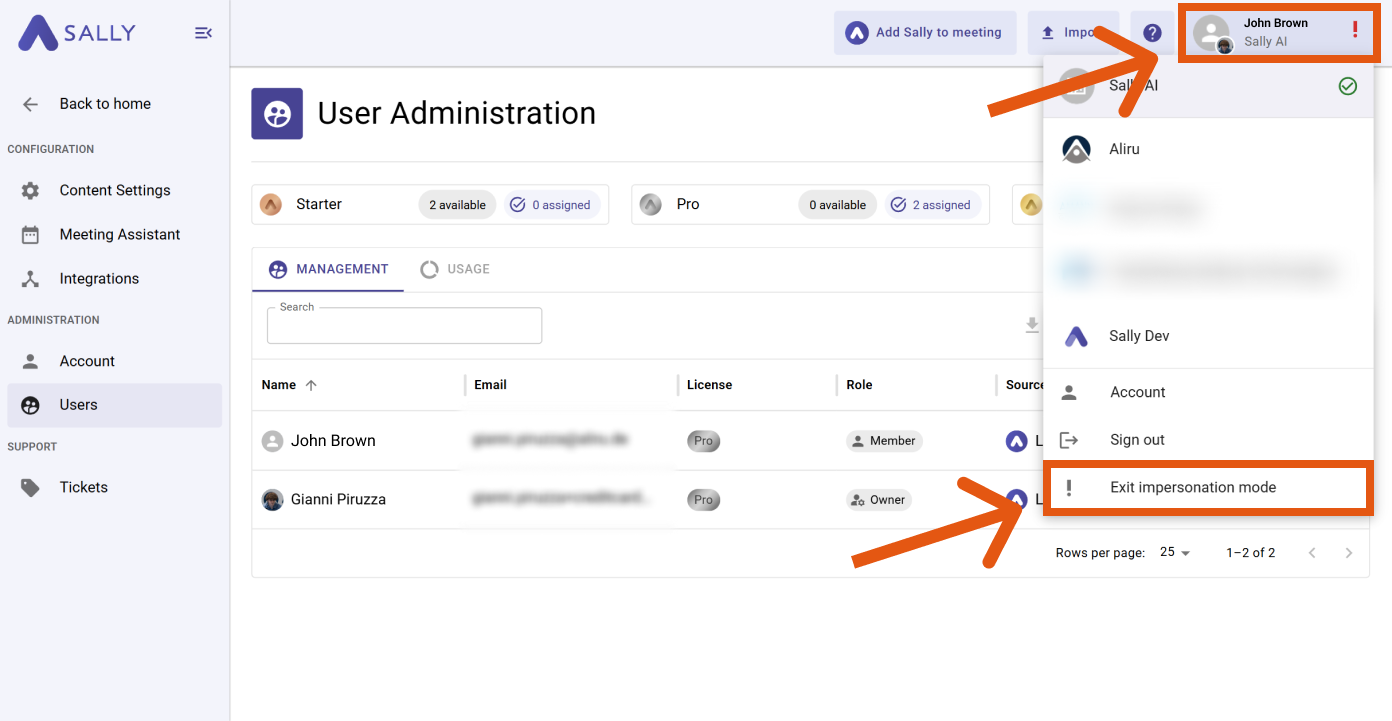
Exit impersonation mode from the user menu
You will immediately return to your original account.
4. Data protection and compliance
Impersonation mode is intended exclusively for temporary representation in a business context, such as absence coverage or operational continuity.
Important principles:
- Access is governed by your organization’s existing role and permission structure.
- Impersonation does not bypass access controls.
- No autonomous actions are performed by Sally.
- All actions require active user initiation.
Organizations are responsible for defining internal policies regarding when impersonation may be used (e.g., documented absence scenarios).
Sally processes meeting data strictly within the defined business environment of your organization. Access to recordings, transcripts, and summaries remains subject to your configured roles and permissions.